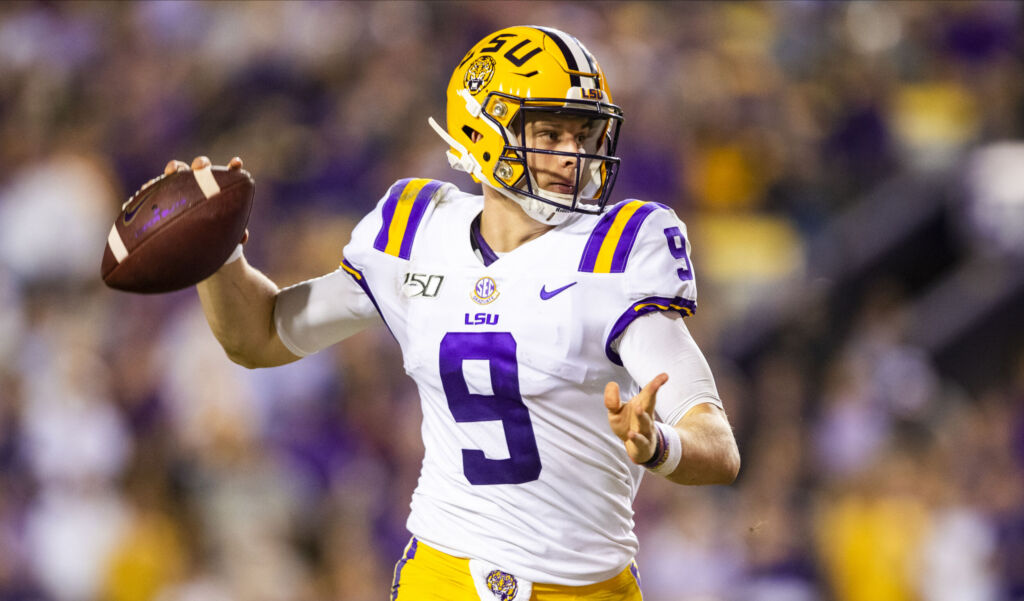
LSU QB Joe Burrow in 2019. / Photo by Gus Stark/LSU Athletics

The most prestigious award in college football.
LSU QB Joe Burrow in 2019. / Photo by Gus Stark/LSU Athletics
Lane Kiffin has experience with the Heisman Trophy. He was an assistant coach at USC under Pete Carroll when the Trojans won three in four years with Carson Palmer (2002), Matt Leinart (2004) and Reggie Bush (2005). A decade later, he was part of Nick Saban’s Alabama staff when Derrick Henry won the trophy (2015).
While at Ole Miss, Kiffin guided a pair of quarterbacks to top 8 finishes in Heisman balloting, including Matt Corral in 2021 (seventh) and Trinidad Chambliss in 2025 (eighth).
Now he’s at LSU, a school that boasts three Heisman winners of its own, including two of the past seven in Joe Burrow (2019) and Jayden Daniels (2023).
On Saturday, Kiffin will take his new team, the No. 7 ranked Tigers, to play at his old school, the No. 8 ranked Rebels. There are not enough terabytes in the world to cover all of the storylines surrounding this game, so we’ll stick to the Heisman-related ones.
Mississippi QB Chambliss is a returning Heisman hopeful looking to become the Rebels’ first Heisman winner and just its second finalist (Eli Manning, 2003). LSU is led by QB Sam Leavitt, who hopes to join Burrow and Daniels as transfers to Baton Rouge who joined the Heisman Fraternity.
The path for all three of LSU’s Heisman winners has taken them through meetings with Ole Miss, the past two in Oxford.
In 2023, Daniels’ burgeoning Heisman campaign was just gaining steam heading into the final Saturday in September when the Tigers took on the No. 20 Rebels. In a game that featured more than 1,300 yards and 100 points, Ole Miss bested LSU, 55-49.
Daniels did his part, completing 27-of-36 passes for a season-high 414 yards and four TDs while also rushing for 99 yards and a score. Daniels was out-dueled by Rebel QB and current New York Giants starter Jaxson Dart, but it was not enough to sidetrack his Heisman campaign.
Four years earlier, Burrow also took the Tigers into Oxford, this time in mid November. And like Daniels, Burrow turned in an epic offensive performance, throwing for a regular-season-high 489 yards on 32-of-42 passing with five TDs in a 58-37 win. The win moved LSU to 10-0 as it marched toward what would become a 15-0 national championship season.
A couple generations earlier, Billy Cannon made history against second-ranked Ole Miss on Oct. 31, 1959, with his famous Halloween Run. A play well documented in Heisman lore and one we revisit annually, Cannon returned a fourth-quarter punt 89 yards — breaking numerous tackles in the process — en route to the end zone with a virtual Heisman-clinching play.
Cannon rushed for 48 yards on the day and returned two other punts for another 31 yards, but it was his Halloween run that became an instant classic.
Although the Rebels have not won a Heisman, the LSU-Mississippi rivalry has had trophy implications for them as well.
In 2003, the aforementioned Manning led an 8-2 Rebel team against the Nick Saban-coached 9-1 Tigers. A leading Heisman contender, Manning took Ole Miss into the game on a six-game win streak with a chance to secure a spot in its first SEC Championship game. But the momentum stopped against LSU. Manning was limited to 200 yards on 16-of-36 passing with one score, his Heisman chances severely dented.
Let’s pivot back briefly to the 1959 Halloween run for one more anecdote on the reach of the LSU-Ole Miss rivalry as it relates to the Heisman.
The Ole Miss punter who booted the ball to Cannon doubled as the Rebels’ QB. That would be Jake Gibbs, a multi-talented athlete who was also a star on the Mississippi baseball team.
Gibbs and the Rebels got a measure of revenge two months later in the 1960 Sugar Bowl when Ole Miss whitewashed LSU, 21-0.
A season later, Gibbs finished third in the 1960 Heisman balloting behind Navy halfback Joe Bellino and second-place Tim Brown, a guard at Minnesota.
Bellino won the Heisman comfortably while Gibbs led the Rebels to a 10-0-1 season. But what if Ole Miss had been 11-0? Would that have swayed a few votes?
As it was, Minnesota, led by Brown, won the AP title despite an 8-2 mark. While Navy took home a Heisman, Ole Miss did claim the Grantland Rice Trophy as national champions, voted on by the Football Writers Association of America.
But who handed the Rebels’ the only blemish on the schedule? LSU of course, in a 6-6 tie.
Completing our Heisman anecdote, Gibbs went on to a professional baseball career following football, signing with the New York Yankees in 1961. Initially an infielder, he was converted to catcher and took over part-time catching duties after Hall of Famer Yogi Berra retired.
Gibbs played in 538 games for New York in parts of 10 seasons, eventually retiring as a another Yankee legend took over the catching job, one Thurman Munson.