

Why Your Heisman Hopefuls Fan Vote Matters More Every Week
In this year’s Heisman Hopefuls Fan Vote, every ballot you cast carries increasing influence as the college football season unfolds. While fans can vote daily for their favorite players, each vote is weighted more heavily as we move closer to Conference Championship Saturday.
Developed by the Carnegie Mellon Sports Analytics Center (CMSAC), this dynamic voting model weights votes in each week based on how much more we learn about players and teams as the season progresses. As a result, fan votes cast later in the season carry greater weight, helping ensure the rankings reflect the strongest and most complete body of work.
How Your Vote Grows Over Time
More details about this approach are discussed in a high-level overview below, but the result is a set of weights where your vote counts for more the closer we are to the end of the season. As seen in the chart below (solid gold line), this culminates in the final week before Conference Championship Saturday where a single vote is worth roughly 18 times more than votes cast at the start of the season.
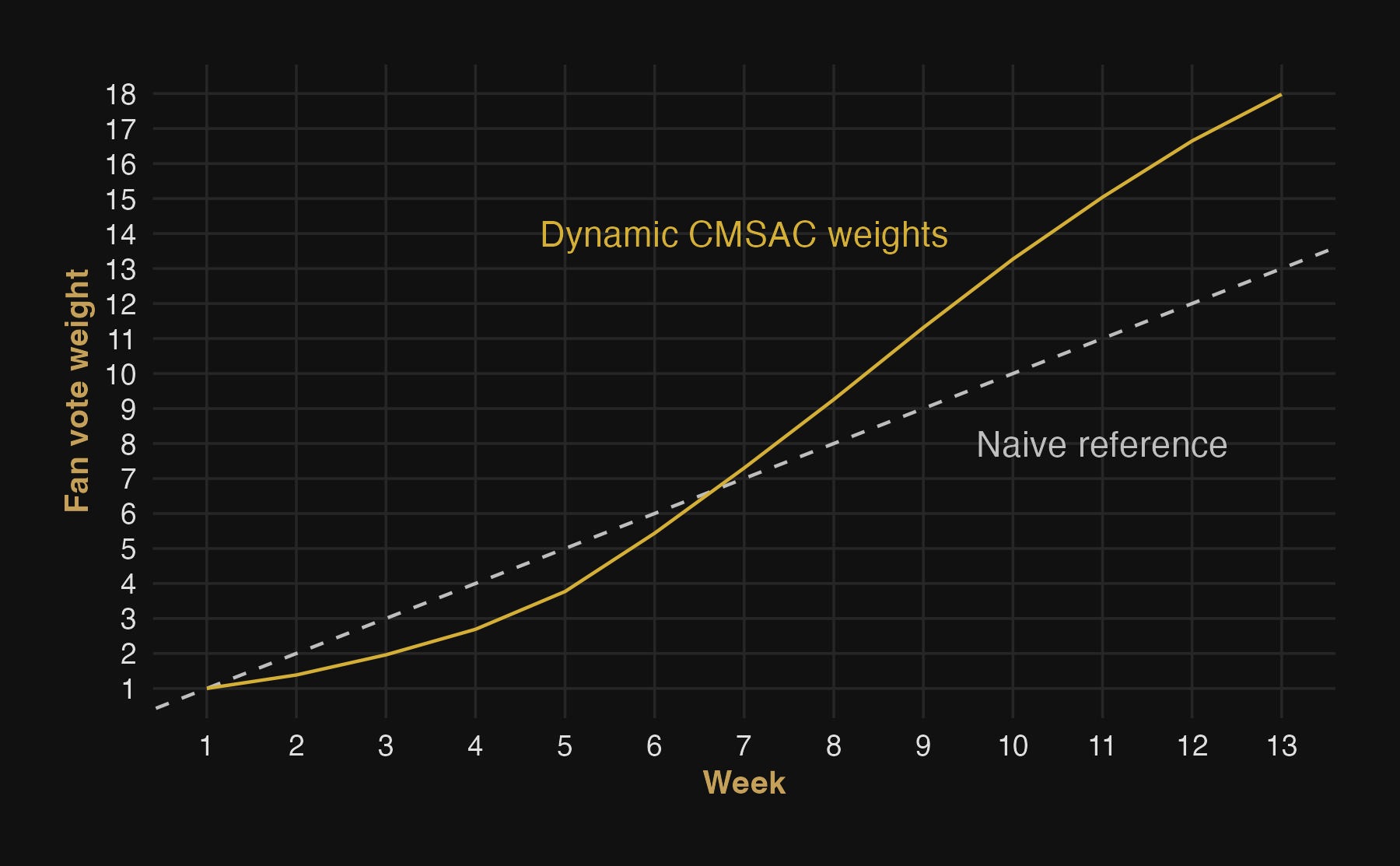
The dynamic CMSAC weights intuitively capture the progression of the college football season:
- Weeks 1-5: early-season, with smaller weights as teams settle in
- Week 6-7: mid-season, inflection point where the vote weight gains momentum
- Weeks 8-13: late-season, with larger weights signaling more complete data
As early non-conference games wrapped up and lineup changes settled in, we observed more complete data around player and team performances. This is why the late-season votes carry the most weight. They reflect a full season’s worth of data and help identify the players who rise to the occasion when the stakes are highest.
The Math Behind the Fan Vote
The CMSAC research lab created this dynamic weighting system by applying advanced sports analytics modeling to five seasons of game outcomes (2021-2025):
- Bayesian State-Space Modeling: CMSAC used a Bayesian state-space model to evaluate team strength ratings week-by-week and across seasons. This model accounts for early-season volatility, like non-conference games and roster adjustments, as the ratings evolve over the course of the season.
- Measuring Information Distance: Using the end-of-season ratings as the anchor, CMSAC measured how much information each week has relative to the complete season using Kullback-Leibler (KL) Divergence. This gives a measurement for ‘how far away’ early weeks are from the final measure of team strengths.
- Proxy for Player Performance: Since there are a limited amount of statistics covering every position in college football, we use team strength as it reflects individual player contributions. By tracking team evolution, this serves as a proxy for how much information we have about players and their performance over a complete season.
Rather than using a naive straight-line increase approach (dashed gray line in the chart above), the dynamic CMSAC weights accelerate vote value during the late-season stretch when the data are most complete.
Looking Ahead
Heisman and CMSAC are continuously expanding college football data and analytics coverage across all programs and positions. Because every player is a Heisman Hopeful, our goal is to combine elite statistical modeling with fan passion to accurately capture excellence on the field.
Make your voice heard—vote today and return every week as the Heisman race heats up.
You can hear Ron Yurko, the Director of CMSAC, discuss this in the Heisman Hopefuls podcast.