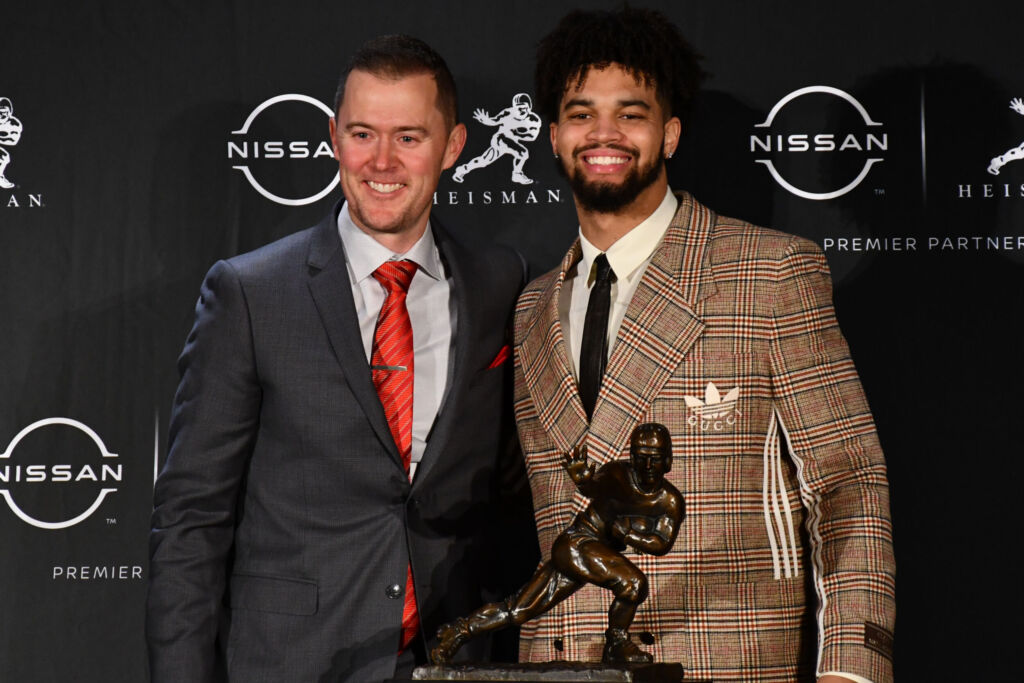
Lincoln Riley and Caleb Williams at the 2022 Heisman Trophy ceremony. Credit: Paul Goldberg

The most prestigious award in college football.
Lincoln Riley and Caleb Williams at the 2022 Heisman Trophy ceremony. Credit: Paul Goldberg
The Official Heisman Trophy Podcast is producing monthly episodes this spring and summer because we know your love for college football doesn’t stop when the season ends. The latest episode includes interviews with Indiana Coach Curt Cignetti, USC Coach Lincoln Riley and 2019 Heisman Humanitarian Award winner and Olympic gold medalist Kristi Yamaguchi.
This story is adapted from an interview on the Heisman Trophy podcast. Listen to the full conversation here. Episodes and clips of The Official Heisman Trophy Podcast are available on all major podcast networks, including Spotify and Apple, as well on YouTube and TikTok.
You can also watch host Chris Huston’s complete interview with Riley below.
Only four head coaches in the history of college football have coached three or more Heisman Trophy winners. Frank Leahy did it at Notre Dame. Nick Saban did it at Alabama. Pete Carroll did it at USC. And Lincoln Riley, the current USC head coach, is the only active member of that club—two winners at Oklahoma, one at USC.
On a recent episode of the Heisman Trophy podcast, Riley sat down with host Chris Huston to explore a question worth asking of any coach who has been this close to greatness this many times: is there a through line? When you strip away the different body types, the different paths, the different eras—is there something common to all of them?
Riley’s answer was immediate and unequivocal. The trait that matters most, the one that precedes everything else, is self-belief.
Three Paths, One Destination
The résumés could hardly be more different. Baker Mayfield arrived at Oklahoma as a walk-on, a player who drew little recruiting interest and had to claw for every opportunity. Kyler Murray was perhaps the most decorated high school player of his generation—a dual-sport prodigy out of Allen, Texas, who transferred from Texas A&M and then sat behind Mayfield for two years before ever taking a meaningful snap at OU. Caleb Williams entered midway through a blowout loss to Texas as a true freshman and never looked back, then followed Riley across the country to USC, where he won the Heisman while helping restart a program from scratch.
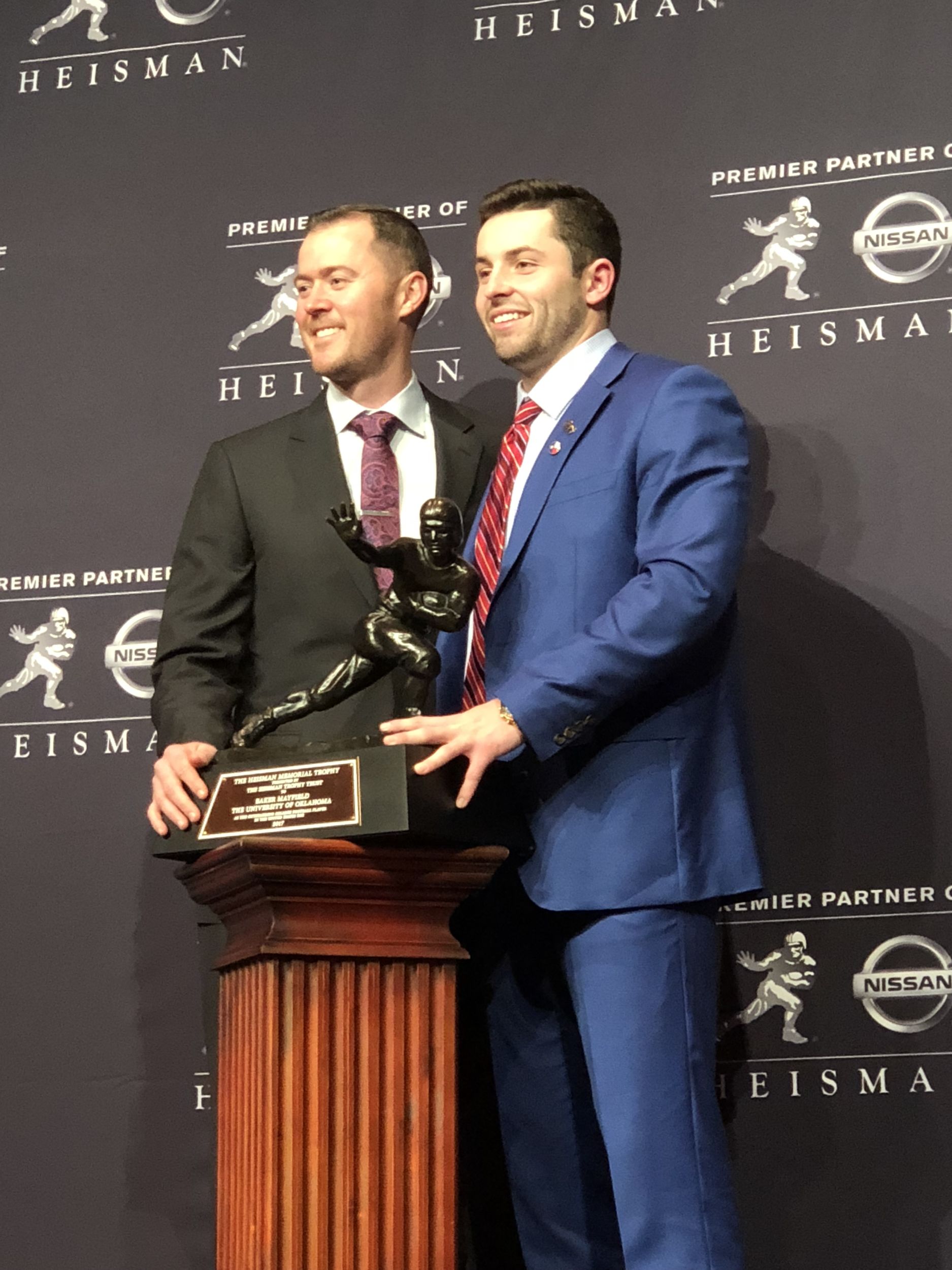
Riley sees no contradiction in the variety. He sees confirmation.
“What if Baker had been in Kyler’s situation?” Riley said. “Or Caleb in Baker’s? I honestly believe any of them would have made any of the situations work, because that’s how they were wired. They were super competitive. They weren’t going to make excuses. They weren’t going to let anything be their crutch.”
The Lonely Position
Riley returned often to the particular demands of the quarterback position—not the physical demands, but the psychological ones. The quarterback is the one player everyone watches, whether they know football or not. Successes are visible. Failures are more so.
“Playing that position is lonely,” Riley said. “Your failures are going to be on display for everybody. You really have to believe in yourself, and you really have to have a true confidence about you. I think that’s something that’s a little hard to teach.”
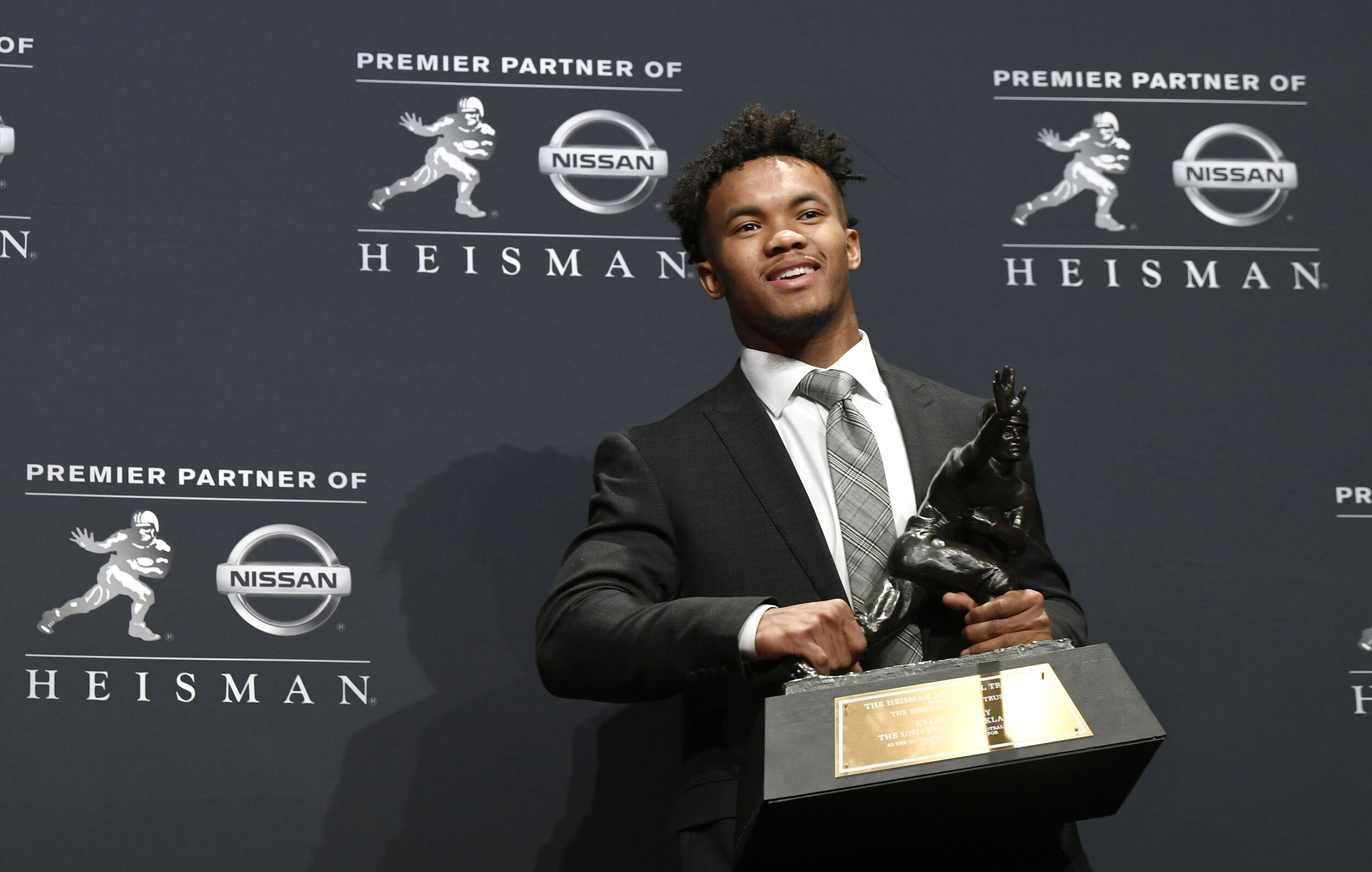
Each of Riley’s three winners found that confidence by a different route. Mayfield’s was outward—a chip on his shoulder, in Riley’s memorable phrase, “the size of the state of Texas.” Murray’s was internal, a quiet certainty that burned hotter the more people doubted him. Williams’ revealed itself in a moment most people never heard about.
“The Heck with It”
During recruiting, Riley had offered two quarterbacks for the same class. When the other prospect committed first, Riley called the Williams family to deliver the news: he wouldn’t be able to recruit Caleb. The family flew out to a game on their own anyway. Riley told them he wouldn’t even meet with them, out of loyalty to the committed player. Their response: they’d walk on if they had to.
“That edge,” Riley said. “‘I’m going to go prove it. You don’t think you’re going to take me? I’m going to prove to you one way or another that I’m the right guy.’ After that happened, deep down, I was like—all right, that told me everything I need to know about this guy.”
The other recruit ended up staying closer to home. Riley pivoted back to Williams. The rest is history.
The Barometer
Riley has coached enough quarterbacks to know the danger of falling in love with physical talent. He acknowledged it plainly: talent is tempting, and every coach has made decisions they wish they could take back.
Over time, he has developed what he calls his inner barometer. He wants to be excited about what he sees on tape, but equally excited about the conversations he has with the player—about working with the person, not just the athlete. If both sides of that equation are strong, the prospect meets the criteria. If only one side is, Riley has learned to walk away.
“That’s maybe helped me avoid a few through the years where the talent was tempting but maybe a part of the personality or the work ethic wasn’t the right fit,” he said. “I’ve got to be pretty excited about both.”
Murray was a case where both sides were overwhelming. Riley recalled watching him at Allen High School, where Murray was leading one of the most storied programs in Texas on a legendary run. “I thought he was as good as anybody I’d ever seen,” Riley said. “He made the game look easy, and that’s not an easy game.”
What Riley didn’t expect—what perhaps even Murray didn’t expect—was that football would become the primary path. Murray was drafted ninth overall by the Oakland A’s as a baseball player. The plan had always been baseball. But midway through Murray’s starting season at OU, during a bye week, Riley sat him down and told him something no one else had.
“I want you to know,” Riley recalled saying, “based on what I’m seeing, you could play football for a long time too.”
Riley believes that conversation was one of the first times Murray seriously considered it. Within months, Murray would declare for the NFL Draft. He went first overall—making him the only athlete in modern professional sports history to go top 10 in two major drafts.
The Next Generation
Asked about the modern reality of college football—the NIL marketplace, the outside interests, the brand-building—and whether it poses a risk to performance, Riley pushed back against the premise. He sees the broadening of the college athlete’s identity as a positive development, not a threat. Too many athletes, he said, reach the end of their playing careers without a plan or an identity beyond the game. Players who cultivate interests and build platforms while they play are better prepared for what comes after.
Riley pointed to Fernando Mendoza, the most recent Heisman winner, as a model: a player who managed internships, a degree, and a range of outside interests while still performing at the highest level on the field. “He’s a good role model for a lot of guys on how to do it well,” Riley said, “how to build a great reputation on top of also becoming a really productive football player.”
As for his own current quarterback, Jayden Maiava, Riley sees familiar ingredients. Maiava is quieter than Mayfield or Williams—somewhere in between all of them, Riley said—but he shares the same competitiveness, the same team-first orientation, and the same appetite for the biggest moments.
“He’s one of those guys who wants that and craves it,” Riley said. “And that’s one of the things I like about him the most.”
Whether Maiava will reach the heights of his predecessors remains to be seen. But if Riley’s barometer is to be trusted—and the evidence suggests it should be—the raw material is there. The rest, as it always does, will come down to belief.
The Heisman Hopefuls Podcast, in its fourth year interviewing the…
The first two-and-half NFL seasons for 2021 Heisman Trophy winner…

Heisman winners are honored in myriad ways by their schools…
Thirty years ago this week, 1996 Heisman winner Danny Wuerffel…