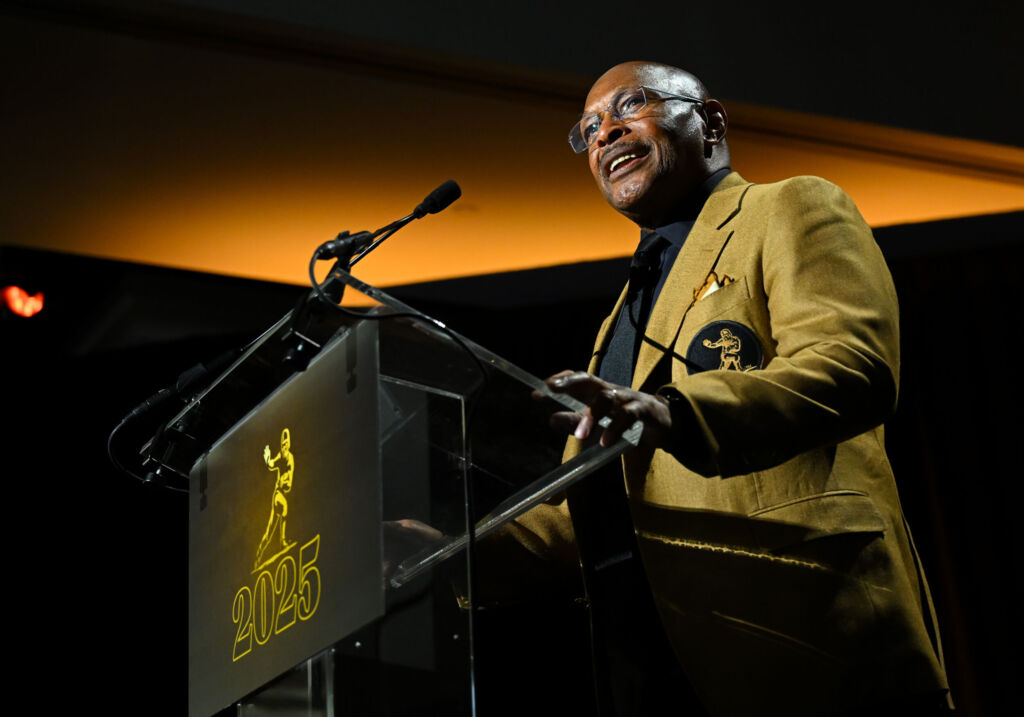
Archie Griffin, speaking at the 2025 Heisman Legends Brunch while celebrating the 50th Anniversary of his 1975 Heisman. / Credit: Heisman Trophy Trust

The most prestigious award in college football.
Archie Griffin, speaking at the 2025 Heisman Legends Brunch while celebrating the 50th Anniversary of his 1975 Heisman. / Credit: Heisman Trophy Trust
New York City sports pages in the mid 1970s were full of larger-than-life heroes — Catfish Hunter, Joe Namath, Tom Seaver, Phil Esposito and Walt Frazier.
Archie Griffin is a son of Ohio, but became an honorary Big Apple sports icon with December feats as special as any that went down at Madison Square Garden or Flushing Meadows. In a city famous for its premiers, Griffin’s 1974 Heisman Trophy victory was a triumph with big headlines in all the tabloids. Five stars, no notes.
A year later, Griffin returned to Gotham for one of the most memorable repeat performances in American sports history, becoming the first — and still only — two-time winner of the Heisman Trophy. It was a sequel worthy of front pages and red carpets. But we’re talking The Ohio State. Make it a scarlet carpet.
Griffin has returned to New York many times in the ensuing decades, including last year when the Heisman Fraternity celebrated the 50th anniversary of his 1974 Heisman.
He’s back in Times Square, making history again, the first Heisman winner to celebrate two 50-year anniversaries.
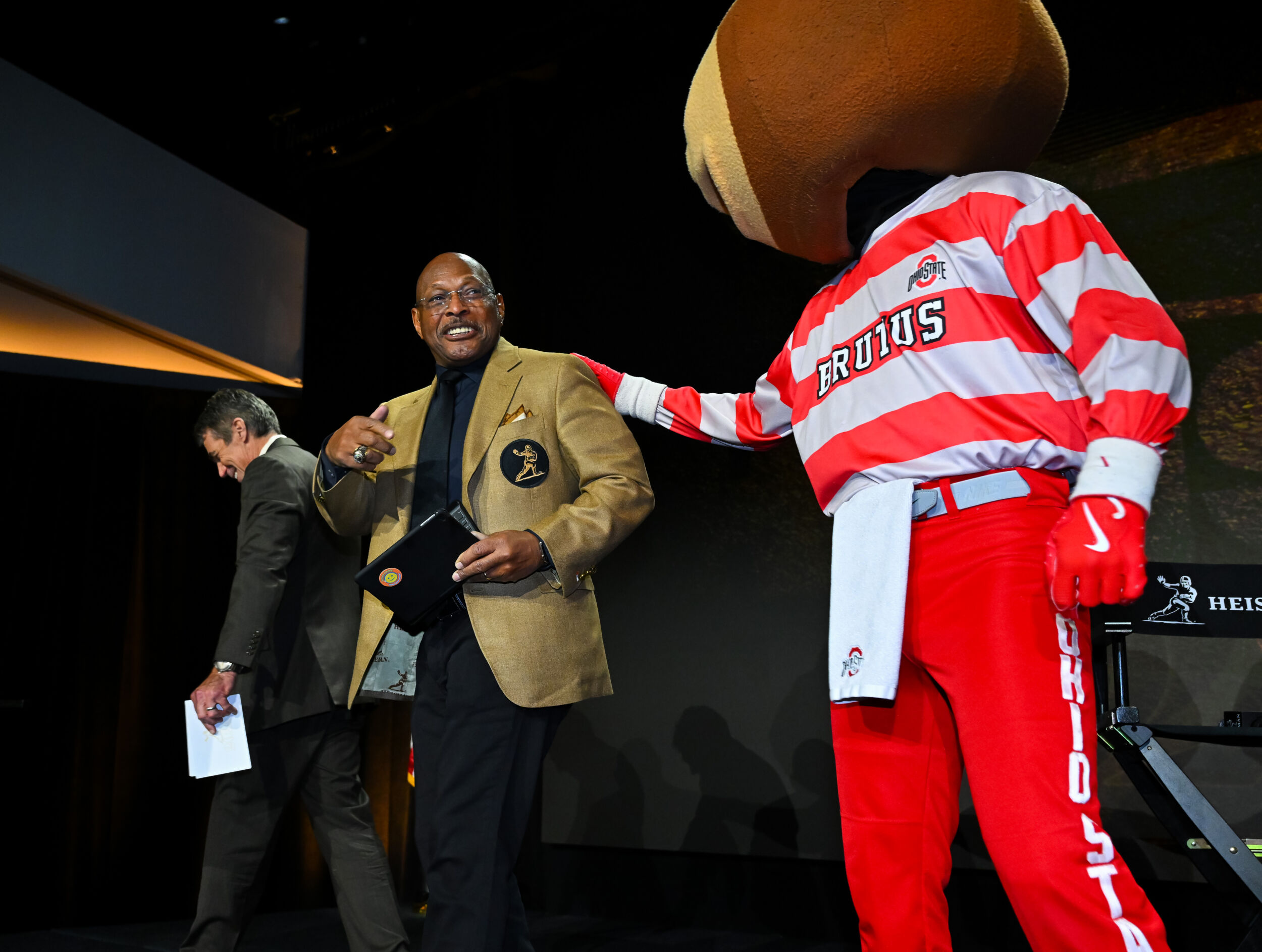
Griffin was born in the shadow of Ohio Stadium on Aug. 21, 1954, about a mile away — or some 1,700 yards — from the Buckeyes’ 50-yard line. That’s about as many yards as Griffin ran en route to his first Heisman, a standard he set out to match in 1975.
One of eight children with six brothers and a sister, Griffin came from a big a family with West Virginia roots which moved to Columbus not long before Archie was born.
His parents both worked multiple jobs to support the large household, setting a work ethic for the family that all the children followed. Griffin was born between three older brothers and three younger ones — all of whom starred in football at various levels — and also had a baby sister who also became an athlete. All eight Griffin children became college graduates.
Griffin attended Eastmoor High and helped the Warriors to a pair of Columbus City League championships. Recruited heavily across the country, Griffin strongly considered a scholarship offer from Northwestern.
But his parents were already putting heavy miles on the family car to watch his older brothers play in Louisville, Muskingum and Akron. Perhaps a bit of a guilty conscious about his parents’ gasoline bill — coupled with a heavy dose of the hard sell from Ohio State’s legendary coach Woody Hayes — turned him into a Buckeye.
The NCAA began permitting true freshmen to participate in 1972, allowing Griffin to play immediately. He proved he was ready for the collegiate game almost immediately, breaking Ohio State’s single game rushing record with 239 yards against North Carolina in his second career outing.
That was a big chunk of his 867 yards gained as a freshman as he helped the Buckeyes to the first of four straight Big Ten titles and Rose Bowl appearances.
In 1973, Griffin became the first Buckeye sophomore to rush for over 1,000 yards, gaining 1,577 yards while earning All-American first team honors, finishing fifth in the Heisman voting. Ohio State, ranked first most of the season, pounded USC in the Rose Bowl and finished 10-0-1. But a 10-10 tie to Michigan in the earlier Big Ten finale cost them a national title.
Then came 1974. Not to state the obvious — or maybe to accentuate the obvious — but you can’t become the only Heisman winner to win the trophy twice without breaking through the first time. And Griffin didn’t just break through, he shattered all expectations.
Griffin finished the 1974 regular season with 1,620 yards and 12 touchdowns on 236 carries, averaging 6.86 per rush while leading Ohio State to its third straight Rose Bowl. He became the Heisman’s 40th winner and Ohio State’s fourth recipient in a runaway, finishing with 1,920 points (including 483 first-place votes), more than twice that of USC’s second-place Anthony Davis (819).
Griffin was the fifth junior to win the award and the first since Navy quarterback Roger Staubach 11 years earlier. Staubach went on to an admirable stint in the Navy ahead of an NFL Hall of Fame career, but his 1964 follow-up season to his Heisman win was modest and he did not finish in the top 8 of voting.
Among the previous four juniors to win the award, Doak Walker came the closest to winning again, albeit a distant third. Griffin’s foundation for a repeat run was robust, returning to a loaded Buckeye team that saw half of its starting lineup boasting All-Big Ten first team honors.
Griffin, however, had a target on his back — and his torso, and his legs and toes and anywhere else an opposing tackler might try to grab to stop the returning Heisman winner from gaining another yard.
In a 1975 New York Times article, Griffin detailed the challenges of playing his senior season while carrying around the weight of the trophy, saying: “Being tagged the Heisman winner, naturally guys on other teams were after me more this year. They all tackled me clean but hard. They might say a few things like. ‘Get up Heisman Trophy winner.’ ”
But get up he did, hundreds of times, en route to history.
Griffin entered 1975 with a streak of 21 straight regular-season games with at least 100 yards rushing and began his quest for history with the season-opener at Michigan State. The Buckeyes disposed of the underdog Spartans, 21-0, avenging an upset loss the previous season. Griffin gained 111 yards on 29 carries.
A week later, Ohio State hosted No. 10 Penn State in the first meeting between OSU’s Hayes and Penn State’s Joe Paterno. Griffin led the Buckeyes’ to a 17-9 win, gaining 128 yards on 24 carries to go with one 23-yard reception.
Griffin and OSU stayed home the next week, hosting North Carolina and treating the Tar Heels to a 32-7 thrashing. The Tar Heels, already the Griffin’s 1972 record-breaking footnote, still couldn’t stop him three years later. Griffin ran for 157 yards on 22 carries, his second-highest rushing total of the season. The effort also helped him break Ohio State’s career total offense record on the same day as the Buckeyes recorded their 500th win in program history. All of that on a day in which his mighty fullback Pete Johnson rushed for a school-record five touchdowns.

Ohio State headed to Los Angeles a week later on Oct. 4, taking on UCLA at the L.A. Memorial Coliseum, which it then shared with USC. Griffin went California dreaming against the No. 5 Bruins, posting a season-best 160 yards on 21 carries while reaching the end zone for the first time of the season. He also posted a season-best 204 all-purpose yards.
The Buckeyes coasted for the rest of the month. On Oct. 11, Griffin ran for 120 yards on 21 carries as newly No. 1 Ohio State shut out Iowa, 49-0. Not much but the opponent changed a week later as the Buckeyes romped over Wisconsin, 56-0, Griffin gaining another 107 yards on 15 carries while scoring his second TD of the season.
Purdue ended OSU’s shutout streak, but not much more, as the Boilermakers fell to the Buckeyes, 35-6 on Oct. 25. Griffin gained another 130 yards, including 94 in the second half, on 20 carries, breaking the NCAA rushing record that day on a 23-yard fourth-quarter carry, his last of the day.
The Lee Corso-led Hoosiers provided top-ranked Ohio State its first test since September in a Nov. 1 game in Columbus. The Buckeyes eked out a 24-14 win and survived a second-half Hoosier rally while Griffin finished with 150 yards on 28 carries.
The Buckeyes cruised to a drama-free win the next week with a 40-3 triumph at Illinois, Griffin rushing for 127 yards for his 30th straight 100-yard game in the regular season. He also broke 5,000 career rushing yards in regular-season action, an NCAA first.
Griffin gained another 124 yards and scored once in Ohio State’s 38-6 win over Minnesota the following week in his final game at Ohio Stadium. The victory clinched either a fourth straight trip to the Rose Bowl or a trip to the Orange Bowl as a consolation prize, depending on how the game against Michigan played out a week later.
Spoiler alert, it came out smelling like roses for Ohio State, although it didn’t start out that way.
A record crowd of 105,543 at the Big House was in attendance to watch the No. 8 Wolverines try to upset Griffin and the Buckeyes on Nov. 22. Michigan took a 14-7 lead after three quarters, but Ohio State rallied with two fourth-quarter scores for a 21-14 win to lock up another trip to Pasadena.
Griffin’s record streak of 31 straight regular-season 100-yard rushing efforts came to a halt with just 46 yards on 19 carries. But as Hayes aptly put it after the game, “If you know Arch, he’ll trade all his records for a victory, like this one.”
Two weeks later, the voting was in and Griffin was a decisive winner of his second consecutive Heisman Trophy, garnering 454 first-place votes en route to 1800 total points. California running back Chuck Muncie was second (730) while USC tailback Ricky Bell was third (708). Pittsburgh junior running back Tony Dorsett was fourth, a year away from making his own Heisman history.
Griffin’s final regular-season totals of 1,357 yards and four touchdowns were more modest than his junior season efforts. But considering he was the focus of every opponent’s defensive game-plan — which helped propel Johnson, his fullback, to his own record-breaking season — Griffin’s efforts in Ohio State’s unbeaten regular season were remarkable.
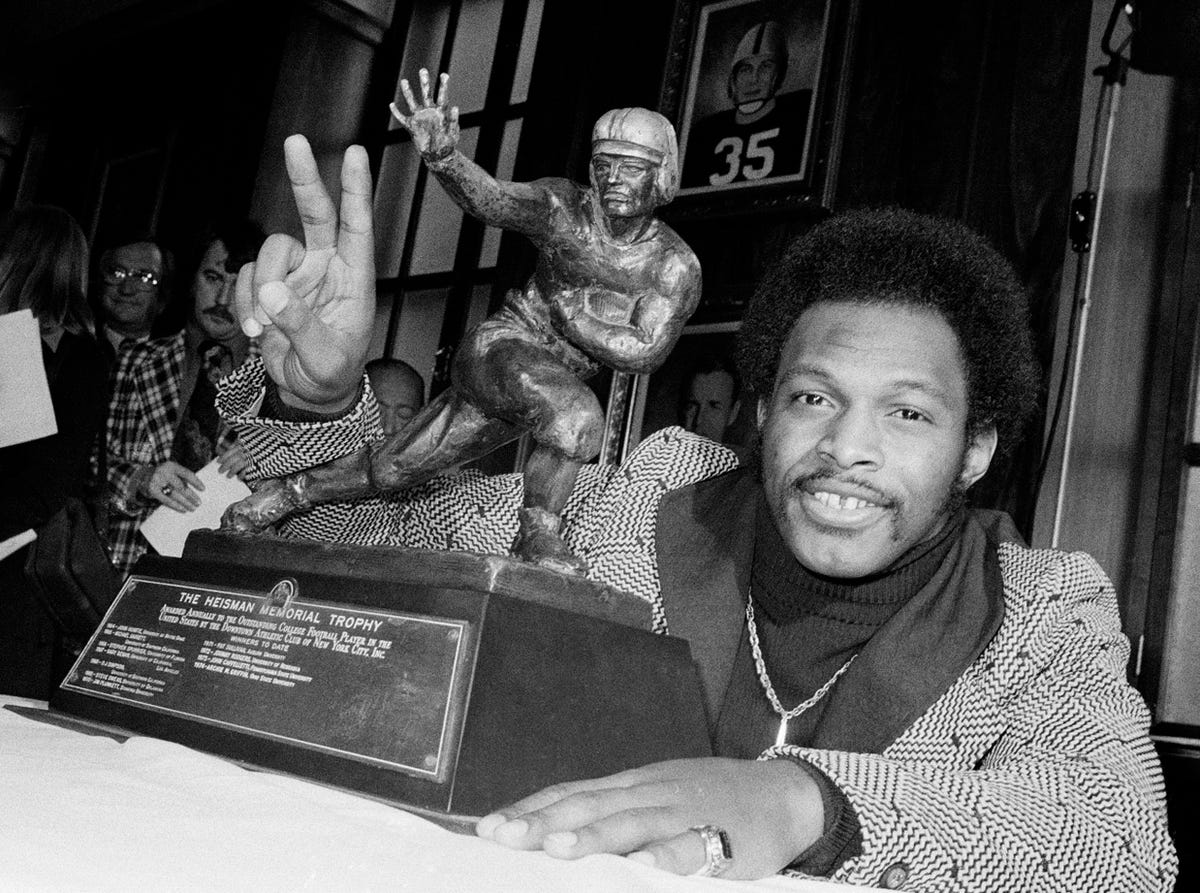
Excluding bowl games, Griffin rushed for a then-NCAA-record 5,177 yards on 845 carries. Including the four Rose Bowls, he rushed for 5,589 yards and 26 scores. That included his final game as a Buckeye, when No. 1 Ohio State fell in the Rose Bowl to revenge-minded No. 5 UCLA, 23-10.
Griffin, who again earned All-American first-team honors, graduated a quarter early from Ohio State with a degree in industrial relations, received the NCAA’s prestigious Top Five Award for combined excellence in athletics, academics and leadership. It is the highest award the NCAA can bestow.
In addition to repeating as the Heisman winner, he received his second straight Walter Camp and UPI Player of the Year honors and also won the 1975 Maxwell and The Sporting News Man of the Year awards.
Griffin became a first-round pick of Cincinnati in 1976, kicking off a seven-year career with the Bengals, which included reaching the 1981 Super Bowl. He joined the staff at Ohio State following his pro career and worked in the Athletic Department for two decades. He was also president of the Ohio State University alumni association for 11 years.
Griffin was inducted into the College Football Hall of Fame in 1986 and into the Rose Bowl Hall of Fame in 1990. He saw his No. 45 officially retired by Ohio State in 1999 on the quarter-century anniversary of his first Heisman.
Congratulations to Archie Griffin, the Heisman Trophy’s first back-to-back 50th Anniversary winner. We’ll have to wait at least 51 years before we get a chance to say that again!