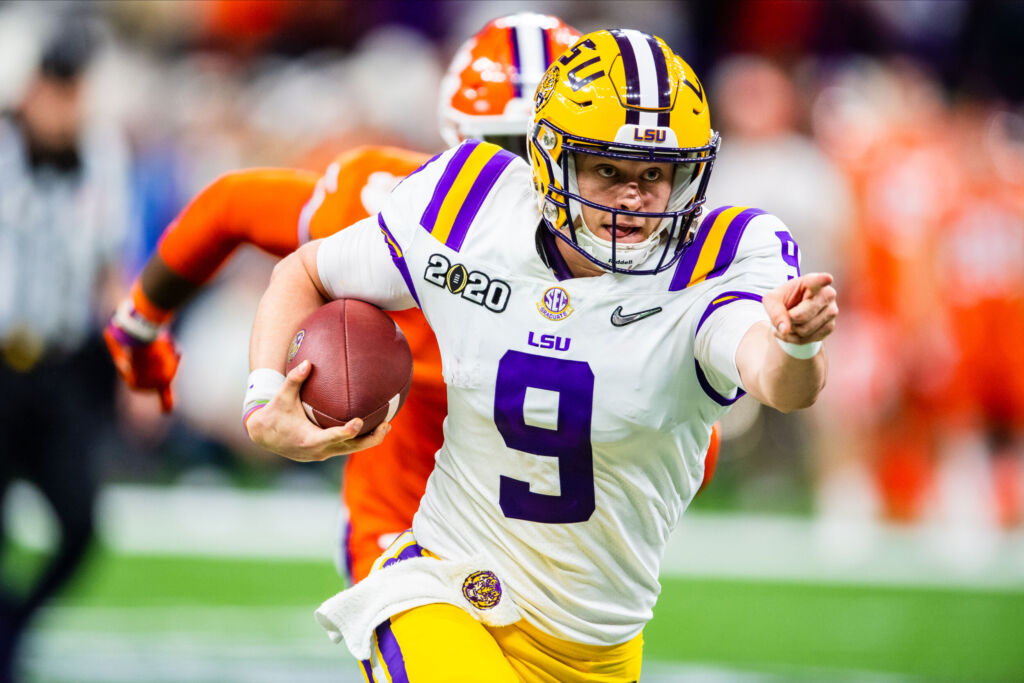
Joe Burrow led LSU to a dominant win in the 2020 CFP finale over Clemson, passing for 463 yards and five touchdowns. Credit: Brandon Gallego/LSU

The most prestigious award in college football.
Joe Burrow led LSU to a dominant win in the 2020 CFP finale over Clemson, passing for 463 yards and five touchdowns. Credit: Brandon Gallego/LSU
The last Heisman winner to win a national championship had such a dominant first half, he didn’t play in the second and still was named the Offensive Player of the Game.
That was, of course, 2020 winner DeVonta Smith, who caught 12 passes for 215 yards and three touchdowns in Alabama’s 52-24 shellacking of Ohio State.
On Monday night, 2025 Heisman winner Fernando Mendoza will lead Indiana in a quest for the Hoosiers’ first national title against Miami. Should Indiana win, he would become the 18th different Heisman winner to win a national title in the same season he captured the trophy.
As for Smith who knows what his totals would have blossomed to had he played in the second half of the CFP final, but a late first-half hand injury kept Smith sidelined. Still, Smith’s first-half numbers were good enough to set national championship game records for most receptions (12), receiving touchdowns (3) and points receiving (18).
Smith and his teammates’ first- and second-quarter exploits sent Alabama to the locker room with a 35-17 halftime lead. Two hours later, Alabama polished off its 2020-21 15-0 season and Smith became the 17th Heisman winner to win a national title.
A year earlier, 2019 winner Joe Burrow put forth a similarly dominant performance in the 2019 CFP title game, completing 31-of-49 passes for 463 yards and five touchdowns while rushing for 58 yards and another score, leading LSU to a 42-25 thumping of Clemson.
Burrow set CFP records for most passing yards (in a four-team playoff) with a whopping 956 yards, including 493 in the semifinal win over Oklahoma (a CFP record). His 521 total yards in the title game, his 1,036 total yards over both games, his 12 total TD passes and 14 total TDs (including two rushing scores) are also CFP four-team records.
Four years earlier, Derrick Henry became the first Heisman winner to lead his team to a title in the CFP era. He rushed for 167 yards and three scores in a 45-40 national championship win over Clemson following a two-TD game in the semifinals.
A quartet of Heisman winners helped their schools win national titles in the BCS era, including Jameis Winston (2013), Cam Newton (2010), Mark Ingram (2009) and Matt Leinart (2004).
You can make the case that Winston turned in the most heart-stopping moment among Heisman winners in title games. His undefeated Seminoles trailed No. 2 Auburn 31-27 with 79 seconds left in the Rose Bowl, doubling as the final BCS Championship ahead of the pivot to the CFP.
The Heisman-winning redshirt freshman was undaunted, leading Florida State on an 80-yard drive — 77 of which came through the air — and firing a 2-yard game-winning TD pass with 13 seconds left.
Newton’s turn in the BCS title game was almost as dramatic. Newton and Auburn capped off an unbeaten season by defeating No. 3 Oregon, 22-19, in the 2011 BCS title game. Despite battling a back injury, Newton completed 20-of-34 passes for 265 yards and two scores and rushed for another 64 yards.
Oregon tied the game at 19-19 with 2:33 left, but Newton led the Tigers on a game-winning seven-play, 73-yard TD drive, capped by a 19-yard field goal as time expired.
Ingram rushed for 116 yards on 22 carries against the nation’s top rushing defense while scoring twice as Alabama disposed of Texas, 37-21, in the 2010 BCS Championship game.
Leinart followed his 2004 Heisman win by leading USC to a dominant 55-19 win over fellow unbeaten Oklahoma in the 2005 BCS title game. He completed 18-of-35 passes for five touchdowns, out-dueling 2003 Sooner Heisman winner Jason White. Future Heisman winner Reggie Bush rushed for 75 yards on six carries in the win.
Three Heisman winners secured national titles in the 1990s, including Charles Woodson (1997), Danny Wuerffel (1996) and Charlie Ward (1993).
Woodson led Michigan to a perfect season in 1997, capped by a 21-16 Rose Bowl win over fellow 1997 Heisman finalist Ryan Leaf’s Washington State Cougars. Woodson had a diving interception in the end zone in the victory and the Wolverines won part of a shared title (they were voted first by AP).
A season earlier, Wuerffel led Florida to the program’s first national title courtesy of a Sugar Bowl win over rival Florida State, 52-20, which also avenged the Gators’ loss to the Seminoles earlier that season.
In 1993, Ward led Florida State to a 13-1 season and an ACC title. The Seminoles captured the program’s first consensus title with a come-from-behind 18-16 win over Nebraska in the Orange Bowl.
Tony Dorsett led Pittsburgh to its only national title in 1976. Leon Hart (1949) and Johnny Lujack (1947) were part of Notre Dame national titles while Felix “Doc” Blanchard led Army to a national crown in 1945.
Angelo Bertelli (1943) was Notre Dame’s first Heisman winner on an Irish national title team. Bruce Smith (1941) led Minnesota to a title while TCU’s Davey O’Brien was the first Heisman winner whose school also captured a national championship.
We’ve made it to June, which might as well be…
If you're a football fan, these are the dog days…

There are 99 days until the return of college football.…
The senior member of the Heisman Fraternity in the NFL…